2018年9月4日星期二

Tiny ‘hearing’ device is 100,000 times thinner than your eardrum

Finding long-range, low-powered sensors for wearable devices is the next scientific frontier. Researchers at Case Western Reserve University are working on atomically thin transducer "drumheads" that can send and receive signals at radio frequencies even greater than those we can hear with our natural ear. Better yet, the drumhead is 10,000,000,000,000 times smaller in volume and 100,000 times thinner than the human eardrum and can detect a much wider range of signal than other similar devices.

The paper, published in the March 30th issue of Science Advances, says that the super small vibrating sensor can detect signals at the highest reported dynamic range of frequencies, up to ~110dB, at radio frequencies (RF) up to over 120MHz. Human hearing is generally in the range of around 60 to 100dB in the range of 10Hz to 10kHz.
While the transducer itself isn't immediately applicable to current devices, the research will likely help inform future devices. "Sensing and communication are key to a connected world," said associate professor and co-author Philip Feng in a statement. "In recent decades, we have been connected with highly miniaturized devices and systems, and we have been pursuing ever-shrinking sizes for those devices."
from Drugdu  https://goo.gl/QgQoHk

Patent Submission – Wearable Biometric Scanner Based EHR System

According to a patent application, it has been reported that Walmart’s current investigation of blockchain technologies have met healthcare demands.
Blockchain technologies have devised a method to obtain a patient’s health records from a blockchain database even if they are unable to communicate. A verification from two different keys is needed for this step.
  • A public key in a wearable scanned by emergency responders via RFID.
  • A private key obtained by scanning a patient’s biometric signature.
Both public and private keys are mandatory to access the patient’s record. The private key would be specific to each individual user.
The spokesperson from Walmart said, “If medical records were stored on the blockchain, the private key of the patient would be needed to view/modify the records. In the case where a user is unconscious or incapacitated in an emergency, a first responder could not access the user's medical records stored on the blockchain; thus, there is a need for a method and system for obtaining a medical record stored on the blockchain when the owner of the private key cannot readily provide the private key.”
For smooth functioning, an RFID scanner is needed to scan the wearable and obtain the public key. Also, a biometric scanning device is needed to verify a bodily feature of the patient (a fingerprint, an iris, a retina, or any facial feature) for accessing the private key. This method would allow the first responders to quickly access the complete health record of the patient. This also ensures that the EHR can be kept inaccessible to others.
from Drugdu  https://goo.gl/QgQoHk

Wearable devices for business vs. fitness

Wearables, like smartwatches and fitness trackers, are popular with business professionals, and for good reason. The devices can collect data and provide insights, allowing wearers to track their fitness and productivity to reach their goals faster.
But some devices may not work the best for business professionals. They may not have enough ways to stay connected in terms of communications, or they may be too focused on physical goals like meditation. And some may stand out too much for professionals in formal business attire to feel comfortable wearing them.
How to choose a wearable for business
Connectivity is the first thing to consider when selecting a wearable for business purposes. Some options can connect to a smartphone, while others work outside of a cellular network. Some professionals need constant access to business communication, and selecting a wearable that works in tandem with a smartphone can provide that.
Think about what you want to accomplish with your wearable. Do you want to just be able to see notifications, or do you need to be able to answer texts and emails as well? What about activity tracking? It can help you understand how you spend your hours to find ways to become more productive, or you can use it for fitness purposes as well.
Apps and integrations can be helpful for business professionals, so check out what is available. Some, especially ones connected to a smartphone, have multiple options, while others have fewer choices. Integrations can streamline things between your wearable and other devices, potentially making you more efficient. Apps can offer new ways to boost productivity.
Mindfulness features are also helpful, especially in high-stress jobs or industries. A sleep tracker can help understand if you're sleeping long or well enough.
Finally, looks aren't everything, but some wearables can stand out when worn with business attire. More wearables are adopting the look of traditional watches, with leather bands and sleek faces. A wearable won't do much if you don't wear it because of its look.
How to choose a wearable for fitness
First, you should consider if you want one device to carry from work to the gym, or if you want separate options. Some popular devices, like the Apple Watch, can work for both environments due to the number of features and connectivity options.
Much like with business wearables, you need to consider what exactly the fitness tracker needs to do. Most will offer the same baseline metrics, but others offer more analytics. How much insight do you want into your workouts? Some only need simple step tracking, but someone training for a marathon may need more detail.
In what physical environment are you going to use the device? Whatever the answer, the tracker should be ready. For example, if you're a swimmer, you obviously need a water-resistant device. Runners may want a device with a built-in GPS so they can track their runs.
You should also consider the tracker's connected app if it has one. What analysis and insights can you get on the app? Does it have features to track food and water intake? Like with business wearables, integrations may also be important, so review the offerings.
from Drugdu  https://goo.gl/QgQoHk

How do Clinical Wearables Impact Patient Care and Quality of Life?

Health technology and clinical wearables are hot topics in the healthcare and pharmaceutical industries. They are creating waves of excitement and talking points for debate, while also topping many of the healthcare trends of this year.

One source suggests that 2018 will be the year of digital health technology, and it is quickly becoming apparent that clinical wearables are one of the most sought-after innovations when it comes to digital health. With the market growing and diversifying in compelling ways, it is worth looking at how clinical wearables are improving access to treatment, enhancing quality of life, and helping with the diagnosis and prognosis of certain conditions. 

What are Clinical Wearables? 

Clinical wearables can be defined as health technology that can be worn by the patient. The wearables contain sensors and use a wireless connection to pass data onto a smartphone or similar device. Wearables are being utilized in the healthcare industry in order to help healthcare practitioners collect, analyze, and leverage patient data for clinical trials, while also significantly improving patient care and overall quality of life. 
Clinical wearables aim to diagnose conditions earlier, minimize hospital stays and reduce invasive treatment options. In addition to this, they can help to cut medical cost and speed up rehabilitation times.

How is the Market for Clinical Wearables Growing?

As the years progress, the potential and ultimate value of clinical wearables are becoming more and more evident, which is why the global wearable medical devices market is set to reach $19.5 billion by 2021. In fact, health technology, in general, is a booming industry, growing by nearly 200% between 2010 and 2014. There now exist over 165,000 health-related apps on the Apple App Store, demonstrating just how in-demand this new form of technology is. 
Behind this surge in popularity are a number of factors, including an aging population, an increased patient interest in healthcare and medicine, and lifestyles that are generally more stress-inducing or challenging. Patients are no longer content to simply let medical professionals take the steering wheel with regards to their health. They want to have a say in their patient care and they want a more personal experience. This is where clinical wearables come in to play. 

How do Clinical Wearables Impact Patient Care and Quality of Life? 

Clinical wearables can help with disease management, monitoring and feedback, rehabilitation and health processes. The use of such wearables can help when it comes to the diagnosis and monitoring of a range of diseases (which will be mentioned below). Wearables can also help patients when it comes to adhering to a care plan, reminding them to take drugs, to calm down, or to seek help. 
The data collected by wearables is even being used to assess the effectiveness of new treatment plans while building mutually-beneficial relationships between doctors and patients. According to one study, of the patients surveyed, 96% of the respondents agreed that the use of clinical wearables helped to improve quality of life. There is also evidence to suggest that the use of wearables can even help to improve the well-being of the patient’s family.
Clinical wearables are being used to treat a range of diseases and disorders
Over the years, there have been huge strides in the field of clinical wearables, and today they are being used to monitor and treat a myriad of diseases and disorders. The hope for many is that the data collected from these devices can go on to not only help individual patients, but to resolve widespread pharmaceutical market access issues. 
Sufferers of asthma attacks now have access to an integrated wearable system that can monitor an individual’s environment, meaning it is possible to predict — and even prevent — asthma attacks.
Wearables are being used to help with the treatment of diabetes. In fact, researchers from the University of Texas have created a clinical wearable tool that measures diabetes-related compounds in patients’ sweat, which can be monitored for up to a week. The creators believe that the wearables give patients more control over their care. 
Wearables are also being helped to monitor Chronic Obstructive Pulmonary Disease (COPD), as they are able to track a patient’s heart rate, blood pressure, blood oxygen saturation, and glucose levels. 
It has recently been stated that the future of improved brain health can be achieved through digital health technology. This is certainly something we’re seeing with Alzheimer’s patients, of whom there are an estimated 47 million worldwide. With the use of wearables and patient monitoring devices, patients are now able to stay at home for longer, with the use of sensors that are placed around the individual’s home and on their body. The impact on quality of life is incredible, as the monitors are able to detect if patients miss a meal, have a fall, or don’t emerge from bed. 
Atrial fibrillation (AFib), the most common heart arrhythmia and a leading cause of strokes, is also being monitored by clinical wearables. The Apple Heart Study app is being used by AFib patients so doctors can monitor data on irregular heart rhythms. This is important as, incredibly, two out of three strokes are actually preventable if AFib is detected and appropriately treated.
On top of the disorders and diseases listed above, there are conditions such as obstructive pulmonary disease, Parkinson’s disease, and hypertension that can be improved and monitored with the use of wearables. As we move forward and technology and medical research advances, it is likely that this list will grow significantly and that patients will benefit from improved care and quality of life.
from Drugdu  https://goo.gl/QgQoHk

Mobile-Health applications and wearables, to improve medication Adherence

Consumers are depending on mHealth applications and wearable devices to improve their medication abidance.

A survey conducted for the Express Script on 800 prescription medication user, founds that half of them trust mHealth technology to help them to become steady and one-third stated that they would like to use mHealth applications or devices if it were installed for them.  Experts say half of all medication users are not consuming their drugs as prescribed, costing $300 billion a year in avoiding healthcare expense. Medication adherence is the biggest issue healthcare experts have aimed to solve more assertively.
Nearly half of those surveyed said, consuming their prescribed drug is the most important part of their health regimen, a percentage higher than those selecting a routine check-up (30 percent). 56 percent said reminders would help them to improve medication stability and 19 percent said, this kind of nudge would definitely help them.
That’s where mHealth comes in.
“The three main aspect of non-adherence comes from cost, clinical or behavioral reasons, and this aspect can be solved through mobile health tools,” said Kyle Amelung, PharmD, BCPS, a senior clinical consultant on Express Scripts.
from Drugdu  https://goo.gl/QgQoHk

LifePlus announces glucose monitoring wearable

Now you can monitor your blood glucose levels just by looking at your wrist if LifePlus has its way. The startup has announced what it has hailed as the first noninvasive continuous blood glucose monitoring multi-sensor wearable.   

Named LifeLeaf, the device has the potential to revolutionize the mushrooming medical wearables segment.
The company announced that the innovative product, whose technological details are not known yet, is undergoing clinical trials in five cities across the world.
The patent-pending invention is based on open standards software and cloud-based analytics. The system gives users real-time notifications and cloud-based AI solutions.
John Trobough, executive chairman of the board, said that the startup, which had been in stealth mode, is excited to announce the introduction of LifeLeaf. He stressed the importance of early detection and management of diabetes and other chronic diseases. He termed LifeLeaf as a unique product and software technology available. “It is truly unique and we are excited to make this multi-sensor capability available to companies and developers globally,” he said.
The multi-sensor smartwatch contains embedded algorithms which extract key parameters, which are then sent to the user’s smartphone interface. Based on the glucose levels, users can decide if they want to alert their doctor.
The device can non-invasively monitor heart rates, chronic health conditions including diabetes, cardiac arrhythmia, congestive heart failure, COPD, sleep apnea, hypertension, respiration rate, blood pressure, and oxygen saturation.
LifeLeaf and LifePlus don’t have clearance from the FDA. The company claims to have the first noninvasive continuous blood glucose monitoring multi-sensor wearable. However, players like Prediktor Medical also have similar wearables currently undergoing development and testing.
from Drugdu  https://goo.gl/QgQoHk

iBeat Raises Investment for its Continuous Monitor mHealth Wearable; Heart Watch

San Francisco-based company iBeat, a mHealth wearable development company has announced new funding from form SCOR Life & Transamerica Ventures and Health Ventures for its mHealth devices, Heart Watch which continuously monitors the heart. iBeat did not state what the total amount was, only that the investments round was “upward of seven figures”.

 “The Heart Watch is one of a kind which keeps continuous monitoring of the heart and offers life-saving assistance in the most critical situation.” Stated Mr. Ryan Howard, founder, and CEO of iBeat.
The mHealth wearable has been developed to continuously monitor heart rates, hypoxemia and blood flow. The watch also alerts the user or emergency services if abnormalities are detected. According to the developers, the device is perfect for the aging populations.
According to iBeat, it is planning to spend the investments on further developments of the Heart Watch and to advance marketing. The company also stated that till now they have received more than 11,000 pre-orders for the Heart Watch will start shipping those orders out this summer.
from Drugdu  https://goo.gl/QgQoHk

Pneumonia Detection mHealth Wearable

Researchers at Jefferson Health’s Sidney Kimmel Cancer Center are studying whether an mHealth wearable used to monitor breathing in asthma patients can be adapted to detect signs of pneumonia in patients with lung cancer.

The researchers - Shivank Garg, MD, a fourth-year resident in the Department of Radiation Oncology, Maria Werner-Wasik, MD, a Professor of Radiation Oncology, and Adam Dicker, MD, PhD, a Professor and Chair of Radiation Oncology at Jefferson – are using the ADAMM (Automated Device for Asthma Monitoring and Management) patch, developed by Health Care Originals.
The three-inch, triangular patch measures respiration rate and characteristics, wheezing, heart rate and temperature, as well as the user’s activity level.
It’s part of a new wave of digital health devices that aim to enhance remote patient monitoring by giving the care team access to continuous biometric data. Along with patches and wearable monitors, healthcare providers and researchers have been studying the efficacy of tattoos, sensor-embedded bandages, clothing, even ingestibles.
Jefferson’s multi-phase study will focus on whether the ADAMM patch can also accurately detect radiation pneumonitis, an inflammation of the lungs in patients undergoing radiation treatment. Those patients who develop pneumonitis often don’t experience coughing, chest pain and congestion until weeks or even months after treatment, making it difficult for the care team to catch the condition at an early stage.
Since the project aims to collect data from patients at home, Garg, Werner-Wasik and Dicker will also be looking to determine whether the digital health patch can be worn comfortably for long periods of time.
“Can patients wear the device as often as we’d like them to?” Dicker asked in a press release issued by Jefferson. “Can they remember the proper way to charge the device, apply the device? What do they think of the device and the intervention as a whole? Is it acceptable to them, do they mind it, do they feel comfortable wearing it?”
In a later phase of the project, Dicker and his colleagues will look to determine whether the data gathered from the patch can be used to detect pneumonia before it actually sets in, enabling the care team to intervene and prevent hospitalization.
Finally, the researchers will also look to gather patient-reported observations (PRO), such as side effects to treatment that doctors might not see.
“If we’re going to compare the data we get from the device and we want to look at quality of life, it is important that we’re using PROs as a measure to compare to because they are better correlated to how patients are actually doing,” Garg pointed out.
The post Pneumonia Detection mHealth Wearable appeared first on Drugdu.com
from Drugdu  https://goo.gl/QgQoHk

Health-Check-Up Through Sweat Monitoring Wearable Device

Cincinnati-based startup Eccrine System has developed a health wearable devices called Sweatronics which tracks your health using sweat. Other bodily fluids like urine and blood contain plenty of the body information’s but are not as easy to collect. However, Sweatronics needs only sweat samples that is produces automatically while working or even sleeping.
The device is to be worn around the wrist, which consists of a sweat collection unit, sensor, and electronics that make contact with skin and uses electrochemical aptamer technology which helps DNA binding to select biomarkers to scale the target of choice, the data can be sent via wireless connection to a smartphone. This device was first introduced to the US air force as a project program.
A recent study showed that individuals could be differentiated from one another due to the unique metabolites in their sweat; each person’s sweat composition profile is unique. The new finding opens up new chances for health monitoring apps.
“The device is constructed in such a way that it not only effectively collects small amounts of fluid, but also isolate the fluids so foreign objects do not affect the sensors”, explained CEO of Eccrine Systems Dr. Gavi Begtrup. Also, the fluids continuously move through the sensors to reflect the body’s current state and do not pool and intermix with old sweat.
Dr. Begtrup said his company plans to use the application on industrial labor. These jobs often involve hours of standing and heavy lifting, and high stress. The use of Sweatronics will help ensure that workers aren’t dehydrated and are safe at work. As the technology gets clinical validation and the FDA’s approval, the company will be looking into several potential medical applications, said Dr. Begtrup.

from Drugdu  https://goo.gl/QgQoHk

Onitor Track – A Weight Loss Wearable

Onitor Track is an advanced biometric, data-driven program which aids in weight loss. Onitor Track combines a personalized weight loss and nutrition program with a dual-positioned wearable via an app.

This device can either be strapped to the wrist or clipped onto a chest band while performing exercise. The wearable behaves like an ECG heart rate monitor where accurate data will automatically be collected and paired with the data provided by the user via the app. This enables the device to deliver personalized nutrition advice and exercise programs according to the data, helping the user to easily achieve their weight loss target.
Amit Ben-Haim, the CEO of Cloudtag and creator of the Onitor brand, said "The Onitor Track succeeds by combining accurate data capture, which helps it build an excellent picture of each user, and smart manipulation of that data to make a fitness and nutrition program that is constantly refined to gain excellent results; Together, these two things show off two great strengths of our business: the hardware and the software, brought together with a highly targeted purpose."
Onitor Track was powered with technology from its parent company named Cloudtag. It is a technology innovation company led by Ben-Haim, an entrepreneur. Ben-Haim is famous as a co-founder of medical device company Biosense, which was later sold to Johnson & Johnson.
from Drugdu  https://goo.gl/QgQoHk

mHealth Wearable Effective in Detecting AFib, STSI Study Finds

Results of the much-anticipated 2016 Scripps Translational Science Institute's (STSI) mSToPS study on 5000 individuals revealed that an mHealth wearable is three times more efficient in diagnosing atrial fibrillation than the traditional screening tests advised by a doctor.

Results of this pioneering study, published this week in the Journal of the American Medical Association(JAMA), validate the efficacy of home-based digital health tools in detecting arterial fibrillation.
In a press release Steven Steinhubl, MD, STSI’s director of digital medicine and an associate professor at The Scripps Research Institute said “Our study shows an almost threefold improvement in the rate of diagnosis of AFib in those actively monitored compared to usual care.
The mSToPS study was launched by STSI in collaboration with Janssen Pharmaceuticals to compare conventional cardiac monitoring with remote monitoring by iRhythm’s Zio patch for ECH screening.
The 5,214 individuals recruited through Aetna’s fully insured commercial and Medicare health plans for this year-long study, witnessed new cases of AF in 6.3 percent of those using the mHealth patch, in contrast to 2.4 percent of the controlled population.
 “This study demonstrates the utility of a digital approach not only to diagnosing asymptomatic AFib but to the clinical research field as a whole,” Steinhubl said in the press release. “We hope that it will set a precedent for future real-world, participant-centric clinical trials that leverage the power of digital medicine technologies.”
from Drugdu  https://goo.gl/QgQoHk

Invention of Cortisol Detecting Wearable to Measure Stress

"/

The research team from Stanford University have invented a novel wearable that could measure the level of a patient’s cortisol from their sweat. Cortisol is a hormone linked to stress, which takes several days to test. This scientific discovery was recently published in Science Advances. 

Onur Parlak, a post-doctoral scholar in the Salleo lab and the lead author, said "We are particularly interested in sweat sensing, because it offers noninvasive and continuous monitoring of various biomarkers for a range of physiological conditions; This offers a novel approach for the early detection of various diseases and evaluation of sports performance.”
This new wearable has a flexible and stretchy sensor known as MS-OECT that could sense cortisol from human sweat. The sensor specifically binds to cortisol and permits other properties, such as proteins to pass through its membrane. 
The authors of this study mentioned, “We introduce the integration of an electrochemical transistor and a tailor-made synthetic and biomimetic polymeric membrane, which acts as a molecular memory layer facilitating the stable and selective molecular recognition of the human stress hormone cortisol; The sensor and a laser-patterned microcapillary channel array are integrated in a wearable sweat diagnostics platform, providing accurate sweat acquisition and precise sample delivery to the sensor interface.”
The research team further added, “In summary, we have demonstrated the integration of an artificial receptor as a biomimetic polymeric membrane for stable and selective molecular recognition using OECTs to produce a wearable sweat diagnostics platform for real-time analysis of the human stress hormone cortisol.” 

from Drugdu  https://goo.gl/QgQoHk

Google Glass Eye-Wearable to Enhance Social Skills among Autism Kids

"/

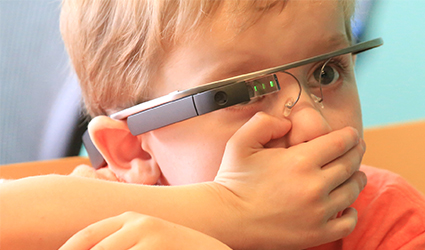
A research team from Stanford University School of Medicine created a smartphone app paired with Google Glass eye-wearable to help children with autism interpret emotions via facial expressions and develop communication skills.
Dennis Wall, PhD from Stanford University and one of the co-author of this study said, "This is a viable strategy to deliver social training; It encourages facial contact and social interaction, but it also provides an appreciation of the salience of emotion, that there is something interesting inherently about human faces. It's exciting, fun, and functional; In fact, the children in the study called it their superpower, so we decided to call it Superpower Glass."
The Google Glass device is linked to a speaker, small screen and a smartphone, which consists of an eyeglasses-like frame with a camera to record the field of view of the wearer. When a child with autism interacts with others, the app immediately identifies their emotions through Google Glass screen or speaker. Using applied behaviour analysis, clinicians are able to teach emotional recognition using flash cards which depict faces with different emotions.
The research was supported by the Hartwell Foundation, the National Institutes of Health, the Bill and Melinda Gates Foundation, the Lucile Packard Foundation, and the Coulter Foundation, as well as grants from Stanford's Precision Health and Integrated Diagnostics Center, Bio-X Center, Beckman Center, the Child Health Research Institute, the Predictive and Diagnostics Accelerator Program, and Human-Centered AI.  
from Drugdu  https://goo.gl/QgQoHk

Fitbit to Include Wearables in Blue365 Health and Wellness Program

"/

Fitbit has generated yet another mHealth partnership in its bidding to make the fitness wearables a major component in connected health programs.
The Blue Cross Blue Shield Association (BCBSA) declared that it would include Fitbit in its Blue365 health and wellness program, giving access to activity trackers and smartwatches for more than 60 million members in 23 affiliated health plans as well as the Federal Employee Program.
Along with the association with UnitedHealthcare and Humana, Fitbit’s deal with BCBSA provides massive exposure in the health plan market.
Mark Talluto, the vice president of strategy and analytics for the BCBSA, said “There is no question that increasing activity and moving more is a tremendous benefit that can improve health, and I'm excited Blue365 members will have even more incentives to get and remain healthy by exercising at a pace that's right for them; This strategic partnership will bring personalized health and wellbeing to the next level, allowing members to put their health first.”
Adam Pellegrini, the general manager of Fitbit Health Solutions said, “Fitbit provides a powerful platform to engage consumers by offering data, insights and guidance to help them meet their health goals; This partnership is an example of how Fitbit is expanding access to our devices and software so that we can help more people focus on their health and wellness and achieve better health outcomes.”

from Drugdu  https://goo.gl/QgQoHk

Use of Digital Health Rises, but Wearables &Telemedicine Falls – Rock Health

"/

A survey spanning 3 years by Rock Health on 4000 U.S residents, to assess their usage and opinions on digital health, revealed that 87% of Americans were using a minimum of one digital health service in 2017 as compared to 80% in 2015.
 “With data from 2015 to 2017, we see a clear upward trend of consumers taking control of their healthcare via the use of digital tools like telemedicine, wearables, and online provider reviews,” Rock Health researchers Megan Zweig, Jen Shen, and Lou Jug mentioned. “… But the needle has not moved equally across every subgroup of the population — nor across every type of digital health solution. … So while digital health solutions promise impactful, even life-altering outcomes for patients, consumers are still transitioning to testing out — and sustainably integrating — these solutions into their lives.”
The survey revealed that online health information was used by 79% of the population while 58% accessed online provider reviews, both services being used the most. However, only 24% used mobile tracking and wearables and live video telemedicine usage stood at 19%. Every service usage has gone up each year barring wearables which remained stagnant at 24% and telemedicine which experienced a fall from 22% in 2016.
Probing into the experience with telemedicine, the survey found that 91% of people, who spent on it, were “moderately” or “extremely” content and 62% of people who didn’t spend money, were satisfied.
It was discovered that 54% of people used wearables in 2017 to increase their physical activity while 40% used it for weight loss and 24% for enhanced sleep and 18% for stress management. Additional findings showed that self-health tracking was largely devoid of digitalization among the population.
from Drugdu  https://goo.gl/QgQoHk

New Wearable Counts Blood Cells, Air Particles

"/

A new wearable designed by researchers from Rutgers University-New Brunswick assert that it can detect blood cell counts and particles in the air. 
"Current wearables can measure only a handful of physical parameters such as heart rate and exercise activity," Abbas Furniturewalla, the study's lead author and a former undergraduate researcher in Rutger's Department of Electrical and Computer Engineering, said in a statement. "The ability for a wearable device to monitor the counts of different cells in our bloodstream would take personal health monitoring to the next level.”
The design of the tool is described in the research published in Microsystems and Nanoengineering. Researchers developed an upper limb wearable that comprises of a microfluidic impedance cytometer on a flexible substrate with a microfluidic biosensor.
The researchers remarked that the system is capable of counting blood cells faster than the standard of care, via a pin-prick blood sample positioned on a standard microfluidic PDMS chip. The system can also transport information along a pathway to process electrical signals and digitize the data with a micro-controller and send it to a Bluetooth module, according to a statement.  
When the system receives the blood cell count, it transfers the data over to a doctor on a smartphone. 
Researchers said it also senses organic and inorganic particles in the air that could affect our health. 
"This would be really important for settings with lots of air pollutants and people want to measure the amount of tiny particles or dust they're exposed to day in and day out,” said Mehdi Javanmard, senior author of the study and assistant professor in the Department of Electrical and Computer Engineering in the School of Engineering.
from Drugdu  https://goo.gl/QgQoHk